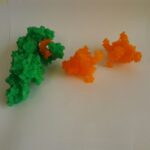
The awesome power of 3D printing for the classroom environment demonstrated once again. The models above were printed based on the protein crystal structures available at the RCSB Protein Data Bank. The image shows the green 1TAU (Thermus aquaticus DNA Polymerase) and orange 1CKQ (restriction enzyme EcoRI, the image shows the two halves of the dimer). The protein models (.pdb files) were loaded into UCSF Chimera and atomic surface representations were created and exported as .STL (thanks to the authors of the software for that). The STL files were scaled, positioned, cleaned up and adaptive supports (45% overhangs) were generated using Meshmixer 2. Supported STL’s were converted to gCode in Slicer v1 at 0.4mm layer height with 3 perimeters and concentric 10% infill. Models were printed on a RepRapPro Ormerod in PLA at 210°C on a hairpray coated 60°C bed.
What RU3DPrinting?
Comments